Launching creates activity. It does not automatically create useful evidence.
A page may attract views. A webinar may fill with registrations. A post may receive encouraging comments. A first cohort may feel busy. None of those numbers, on their own, tells you whether the problem matters, the offer is understood, people will pay, the delivery works or the founder can sustain it.
Measure the smallest set of signals that will help you answer the main question behind your launch. Track whether the right people encountered it, took a meaningful action, understood the offer, paid, used it, benefited and created unacceptable costs or risks. Decide before launching what each result would make you do next.
The aim is not to prove that every launch “worked.” It is to learn enough to make a better next decision.
“Did the launch work?” is usually the wrong first question
A launch can produce plenty of motion and very little clarity:
- impressions without attention;
- registrations without attendance;
- attendance without action;
- payment without use;
- use without benefit;
- benefit that requires an unsustainable amount of founder time.
These are not six versions of the same result. They are six different questions.
The Clinician Founder distinction is:
A launch is not automatically traction. A launch puts a tangible version of an idea into contact with the people it is intended to serve. The response becomes a signal; repeated or sufficiently strong evidence may eventually support a decision.
That distinction matters for clinicians. We are trained to take measurement seriously, but that can lead in two unhelpful directions: collecting everything “just in case,” or borrowing benchmarks from businesses with different audiences, prices, channels and stages.
A smaller, decision-led set of measures is usually more useful.
Start with Question → Launch → Signal → Decision
Question
What are you still unsure about?
Not “Is my business good?” but something narrower:
- Do the right people recognise this problem?
- Will they take a meaningful next step?
- Do they understand the offer?
- Will they pay this price in this context?
- Can we deliver the promised value?
- Does credible proof reduce hesitation?
Launch
What can you put into the world to test that uncertainty?
That might be a listening session, waitlist, workshop, paid founding offer, pilot, beta, case-study campaign or relaunch. The launch format should match the question. A free webinar cannot answer the same question as a completed payment. A sales page cannot tell you whether the service produces its intended outcome.
Signal
What observable behaviour or outcome would help?
The signal might be repeated problem language, completed signups, attendance, payment, activation, completion, a useful outcome, repeat use, referral—or an important safety, equity or workload problem.
Decision
What will you do differently after seeing the result?
Continue, narrow, change, investigate, pause or stop are all legitimate decisions. If no plausible result would change what you do, the metric is probably decorative.
The Institute for Healthcare Improvement's Model for Improvement begins with three questions—including what the team is trying to accomplish and how it will know a change is an improvement—then uses Plan-Do-Study-Act cycles to test and adapt change.[1] The Lean Startup similarly describes a startup as an experiment that attempts to answer a question and uses Build–Measure–Learn to decide whether to pivot or persevere.[3]
The contexts are different, but the shared discipline is useful:
Decide what you need to learn before choosing what to measure.
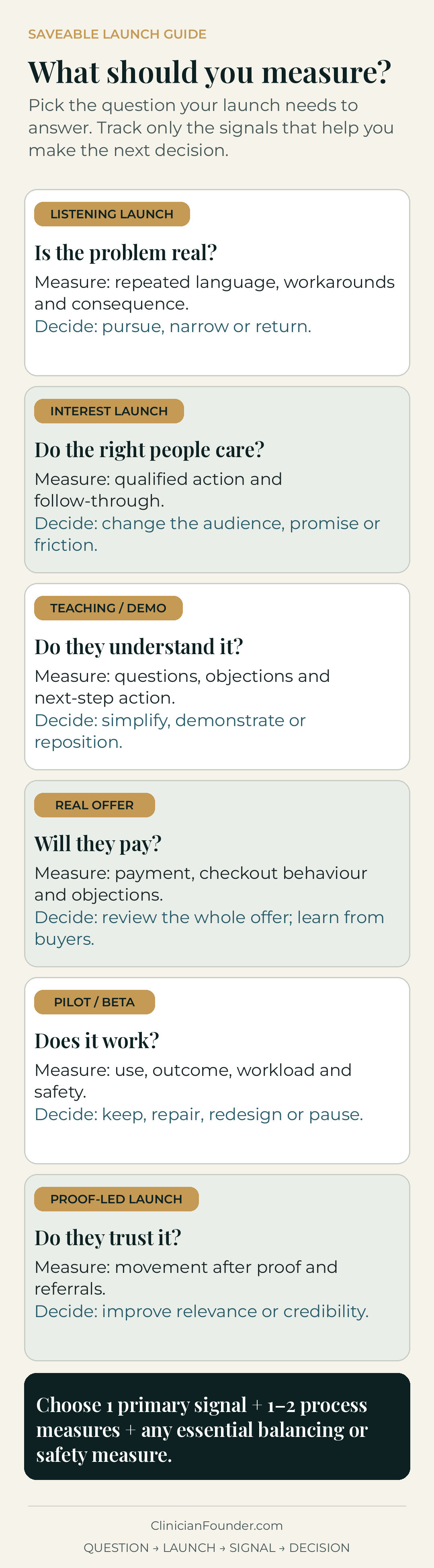
Six questions your launch might need to answer
Choose the question that matters most now. This is the quick reference; the sections below explain what each signal can and cannot tell you.
| Your question | Useful signals | Your next decision |
|---|---|---|
| Is the problem real? | Repeated situations, consequences and existing workarounds. | Narrow the problem or test a stronger commitment. |
| Do the right people care? | Qualified signups, attendance and follow-through. | Review audience, promise or friction; choose the next uncertainty. |
| Do they understand? | Questions, objections and actions after an explanation. | Simplify the offer or investigate what prevents action. |
| Will they pay? | Completed purchases, checkout failures, objections and refunds. | Learn separately from buyers and suitable non-buyers. |
| Can you deliver the value? | Use, outcomes, founder time and any safety or workload problems. | Improve delivery before scaling. |
| Do they trust it? | Meaningful action after relevant evidence or a referral. | Make useful proof easier to find or revisit the uncertainty. |
1. Is the problem real?
Use a listening launch: interviews, a problem clinic, AMA, Q&A, anonymous question form or focused community discussion.
Measure:
- how many suitable people are willing to discuss the problem;
- repeated moments, language and consequences;
- workarounds already in use;
- time, money, effort or reputation already spent;
- evidence that the problem recurs without heavy prompting.
Do not overvalue: likes, “great idea” comments, support from friends, one enthusiastic person or a broad market-size estimate without user-level evidence.
Decision: If accounts are vague and inconsistent, observe or narrow. If the same difficult moment, workaround and consequence recur among the intended audience, decide what stronger commitment signal to test next.
2. Do enough of the right people care?
Use an interest launch: a waitlist, register-interest page, early-access invitation, relevant live event or small challenge.
Measure:
- qualified visits or invitations;
- signups or registrations;
- attendance and follow-through;
- completion of the next meaningful action;
- replies, referrals and return behaviour;
- which audience and channel produced the response.
Do not overvalue: reach alone, audience size, passive “interested” comments or registrations that never turn into attendance.
A contact detail is more informative than an impression. Time and effort generally create a stronger signal than a like. Payment is stronger evidence of buying behaviour than a hypothetical statement—but each answers a different question.
Decision: If the intended audience encountered the offer but few acted, revisit the audience, problem, promise, clarity or friction. If people act, choose whether the next uncertainty is understanding, payment or delivery.
3. Do they understand the offer?
Use a teaching or demonstration launch: a workshop, webinar, product walkthrough, live teardown or before-and-after demonstration.
Measure:
- attendance and completion;
- where people disengage;
- repeated questions and objections;
- requests for clarification or examples;
- clicks and actions after the explanation;
- whether the right people can accurately describe what happens next.
Do not overvalue: applause, pleasant feedback, watch time without movement or views from people outside the intended audience.
Decision: If people care but cannot explain the offer, simplify the promise, demonstrate the mechanism or use a more recognisable example. If they understand but do not act, investigate trust, timing, relevance, price and friction separately.
4. Will they pay?
Use a real offer where appropriate: paid founding access, a first cohort, pre-sale, limited release or small paid beta.
Measure:
- offers made to suitable people;
- completed purchases and failed checkouts;
- time from offer to payment;
- price and non-price objections;
- payment-plan requests or refunds;
- which audience, message and channel preceded purchase.
Do not overvalue: survey willingness-to-pay, compliments about value, pricing-post engagement or “I would buy that” without buying behaviour.
Buffer founder Joel Gascoigne describes starting with a landing page to gauge interest, launching a basic first product and gaining the first paying customer within four days. He says that signal changed the next focus from building more features towards marketing and customer development.[4] This is one founder's retrospective, not a universal target. The transferable lesson is that a signal matters because it changes the work.
Decision: If nobody buys, do not assume price is the only cause. Review problem, audience, promise, trust, offer clarity, timing and payment friction. If some buy, learn from buyers and suitable non-buyers separately.
5. Does it work—and can you deliver it?
Use a pilot, beta cohort, founding-user group, concierge service or small controlled rollout.
Separate three questions:
- Did people use it?
- Did it help in the way promised?
- Can it be delivered safely and sustainably?
Measure:
- onboarding and activation;
- usage, completion and drop-off;
- time to first useful outcome;
- outcome evidence appropriate to the promise;
- retention, repeat use or referral;
- support demand, founder time and delivery cost;
- errors, complaints, privacy issues and escalation needs;
- differences in access or outcome between relevant groups.
Healthcare quality-improvement practice distinguishes outcome measures, process measures and balancing measures. IHI describes outcome measures as the impact on customers or patients, process measures as whether the system's steps are performing as planned, and balancing measures as whether improvement in one part creates problems elsewhere.[7]
For a clinician founder, that could mean:
- Outcome: Did participants achieve the promised practical change?
- Process: Did they onboard, attend and complete the key step?
- Balancing: Did the offer increase workload, exclusion, complaints, risk or unsustainable support?
Decision: Keep what appears useful, repair the process that is failing and avoid scaling until the delivery model and relevant safety boundaries are credible. Business metrics do not replace clinical governance or evidence of clinical effectiveness.
6. Do they trust it?
Use a proof-led launch: a relevant case study, customer story, partner introduction, referral campaign or transparent results breakdown.
Measure:
- movement after exposure to relevant proof;
- replies or questions that reference the evidence;
- referral and partner-channel response;
- whether hesitation changes from “Will this work for someone like me?” to a concrete implementation question;
- whether proof attracts the intended audience rather than merely increasing attention.
Do not overvalue: testimonial volume, vanity logos, generic praise or proof disconnected from the buyer's situation.
Decision: If appropriate proof changes behaviour, make it easier to find. If it does not, check whether the evidence is relevant, specific and credible—and whether trust was actually the main uncertainty.
What healthcare quality improvement can teach founders
A business launch is not a QI project, and a launch experiment is not clinical research. Still, QI contributes useful measurement habits.
IHI says measurement for learning and improvement can use small, sequential samples and “just enough” data, while combining quantitative and qualitative information.[7] Its wider Model for Improvement uses iterative PDSA cycles to test and adapt change.[1] The QI Essentials Toolkit includes run charts, driver diagrams, FMEA and PDSA worksheets.[2]
Four habits translate well:
- Start with an aim. State the audience, intended change and timeframe.
- Use a family of measures. Combine a primary outcome with the process that might drive it and any important balancing effect.
- Look over time. A single spike can mislead; repeated observations show more.
- Seek usefulness, not perfect data. Collect enough to make the next responsible decision.
For patient-facing or clinically consequential work, the boundary is crucial: launch learning does not establish clinical efficacy, safety or generalisability. Use the proper governance, regulatory, research and professional routes.
Three famous launch lessons
Buffer: the useful signal changed the next job
Buffer's founder says the project began with a landing page to gauge interest, followed by a basic product. The first paying customer arrived within four days, after which he shifted attention towards marketing and customer development.[4]
Lesson: Do not celebrate the payment and then continue the same plan unchanged. Ask what that payment makes it rational to do next.
Airbnb: count completed behaviour, not only supply or publicity
Airbnb's founders reported that around the 2008 Democratic National Convention they had about 800 people signed up to host and 80 guest arrivals.[5]
Those numbers describe different parts of the system: potential supply and completed use. Neither should be silently substituted for the other.
Lesson: Name the denominator and the behaviour. Registrations, listings, arrivals and repeat stays answer different questions.
Kickstarter: source and sequence matter
Kickstarter says successful projects often begin with friends and early supporters who share the project with their networks, creating a snowball effect.[6]
Lesson: Segment your evidence. A warm supporter, a referred buyer and a cold visitor may behave differently. Total pledges or signups can hide where confidence is actually coming from.
Famous launches are illustrations, not benchmarks. Their resources, channels, trust and market conditions may be nothing like yours.
Choose a small family of measures
A manageable launch dashboard might contain:
| Measure | What it tells you | Examples |
|---|---|---|
| Reach/exposure | Did the intended people encounter it? | Qualified visits, suitable invitations, source/channel |
| Meaningful action | Did they give time, effort, contact details, reputation or money? | Signup, attendance, reply, referral, purchase |
| Process/use | Did the intended mechanism happen? | Onboarding, activation, completion, response time |
| Outcome/value | Did the promised useful change begin to occur? | Appropriate outcome, repeat use, retained behaviour |
| Balancing/safety | Did another problem appear? | Workload, complaints, exclusions, privacy or safety issues |
| Qualitative learning | Why did the observed result happen? | Questions, objections, reasons for dropout, interviews |
You do not need one metric from every row. Choose the smallest family that answers the launch question responsibly.
For every percentage, record:
- the numerator and denominator;
- the dates;
- the audience and channel;
- what was excluded;
- any material change made during the period.
“Ten people bought” and “10% converted” are incomplete without knowing who was invited, how they arrived and what they were offered.
Decide before the numbers arrive
Write a simple interpretation plan before launch:
- Continue: the intended audience and mechanism show credible support, with acceptable balancing effects.
- Change: exposure was adequate but action, understanding, use or outcome was weak.
- Investigate: the result is ambiguous because the sample, tracking, audience or delivery was inconsistent.
- Pause or stop: the risk, burden, economics or governance problem exceeds what you decided was acceptable.
This prevents the target moving after the result.
A launch is not a referendum on your worth as a founder. It is one bounded encounter between an idea and the people it is intended to serve.
Don't measure everything. Measure what helps you decide what to do next.
Download the free launch measurement guide
The free What to Measure When You Launch guide includes:
- the Question → Launch → Signal → Decision framework;
- a launch-measurement cheat sheet;
- practical examples for products, services, programmes and pilots;
- a pre-launch worksheet for selecting one to three signals;
- a decision page for continue, change, investigate, pause or stop.
One email unlocks the Clinician Founder resource library, including this guide.
Frequently asked questions
How do you measure whether a launch was successful?
First define what the launch was intended to teach. Then measure the relevant behaviour or outcome and compare it with the decision rule you set in advance. Reach may show exposure; payment may show buying behaviour; completion may show use. No single metric establishes every kind of success.
What are vanity metrics in a launch?
A vanity metric is not a fixed category. It is a number that looks impressive but does not help with the decision you need to make. Impressions can be useful when testing distribution, but misleading when used as evidence that people value or will pay for an offer.
What metrics should a service business track at launch?
A service launch might track suitable enquiries, booked conversations, completed payments, onboarding, delivery time, client effort, the promised practical outcome and founder workload. Choose only the measures needed to assess demand, delivery and sustainability at that stage.
Should every launch track conversion rate?
No. Conversion requires a clearly defined numerator, denominator and pathway. During early problem discovery, repeated behaviour and existing workarounds may be more useful than a sales conversion. Avoid applying universal benchmarks from unrelated offers and audiences.
What should a clinician founder measure in a pilot?
Measure whether suitable people start and use the pilot, whether it delivers the intended outcome, what support and founder time it requires, and whether it creates safety, access, privacy or workload problems. A positive satisfaction score alone is not enough.
How many launch metrics should you track?
Use the smallest set that answers the question. A practical starting point is one primary signal, one or two supporting process measures and any essential balancing or safety measure. Add more only when they change a real decision.
Sources
- IHI: Model for Improvement
- IHI: Quality Improvement Essentials Toolkit
- The Lean Startup: Methodology
- Buffer: Reflecting on 10 Years
- Airbnb: 10 Years of Community
- Kickstarter: About
- IHI: Establishing Measures
The launch stories are first-party accounts used as illustrations, not universal benchmarks.